Hair loss and thinning hair can be influenced by many factors, including genetics, hormones, age, stress, medical conditions, nutrition, and changes in the hair growth cycle.
Because the causes vary, effective hair restoration should begin with understanding why the hair is thinning, not simply choosing a treatment based on popularity.
PRF, or Platelet-Rich Fibrin, is a regenerative treatment prepared from a small sample of the patient’s own blood. It contains platelets within a fibrin matrix along with naturally occurring signaling proteins involved in tissue repair and biological communication.
When applied to the scalp, PRF is used with the goal of supporting the environment around existing hair follicles, encouraging scalp health and promoting conditions that may help support the natural hair growth cycle.
At Nature MedSpa, Hair Restoration with PRF is always performed as part of a personalized treatment plan following professional evaluation.
This guide explains how PRF hair restoration works, who may benefit, what the treatment process involves, and what patients should realistically expect.
Table of Contents
- What Is PRF Hair Restoration?
- How Does PRF Work for Hair?
- What Causes Hair Thinning?
- Who May Benefit from PRF Hair Restoration?
- What PRF Can and Cannot Do
- What Happens During a PRF Hair Treatment?
- How Many Sessions Are Usually Recommended?
- When May Results Become Visible?
- PRF for Men vs. Women
- PRF vs. Hair Transplant
- PRF vs. Topical Hair Treatments
- PRF for Scalp Health
- Recovery and Aftercare
- Why Early Evaluation Matters
- Frequently Asked Questions
What Is PRF Hair Restoration?
PRF Hair Restoration is a regenerative scalp treatment that uses Platelet-Rich Fibrin prepared from the patient’s own blood.
A small blood sample is collected and processed to isolate a fibrin-rich preparation containing platelets and signaling proteins associated with tissue repair.
The PRF is then applied to selected areas of the scalp according to the patient’s treatment plan.
Unlike a transplant, PRF does not move hair follicles from one part of the scalp to another.
Instead, the goal is to support the biological environment around follicles that are already present.
How Does PRF Work for Hair?
Hair follicles are living structures that cycle through different phases of growth, transition, and rest.
The health of the surrounding scalp tissue can influence how well follicles function.
PRF contains platelet-derived biological components that participate in normal healing and tissue signaling.
When used on the scalp, PRF is intended to support:
- Follicle vitality
- Scalp health
- Tissue repair
- Hair growth cycle support
- Local regenerative activity
The treatment does not create new follicles.
Rather, it is designed to support follicles that are still present and capable of responding.
This distinction is extremely important.
What Causes Hair Thinning?
Hair thinning may result from several different factors.
Common contributors include:
- Genetic hair loss
- Hormonal changes
- Aging
- Stress
- Nutritional deficiencies
- Thyroid-related conditions
- Postpartum changes
- Illness
- Medications
- Scalp inflammation
- Traction
- Previous chemical or heat damage
Because the underlying cause matters, PRF should not be considered a universal answer for every type of hair loss.
Professional evaluation is essential.
Who May Benefit from PRF Hair Restoration?
PRF may be considered in patients experiencing:
- Early hair thinning
- Reduced density
- Weak or miniaturizing hair
- Certain forms of pattern hair loss
- Reduced scalp vitality
- Progressive thinning without complete follicle loss
Patients who still have active follicles are generally more likely to be appropriate candidates than areas where follicles are no longer present.
This is why early evaluation can be valuable.
What PRF Can and Cannot Do
PRF is sometimes marketed with unrealistic expectations.
A more accurate way to understand the treatment is:
PRF May Help Support
- Existing follicles
- Scalp tissue quality
- Hair density in selected patients
- Hair shaft quality
- The natural growth cycle
- Regenerative scalp health
PRF Cannot
- Create entirely new hair follicles
- Guarantee regrowth
- Reverse every form of hair loss
- Replace a hair transplant when follicles are absent
- Correct an untreated underlying medical cause of hair loss
The goal is biological support, not an instant transformation.
What Happens During a PRF Hair Treatment?
Treatment begins with a consultation and scalp evaluation.
Your provider may assess:
- Pattern of thinning
- Hair density
- Scalp condition
- Medical history
- Family history
- Current medications
- Previous hair treatments
- Duration of hair loss
- Treatment expectations
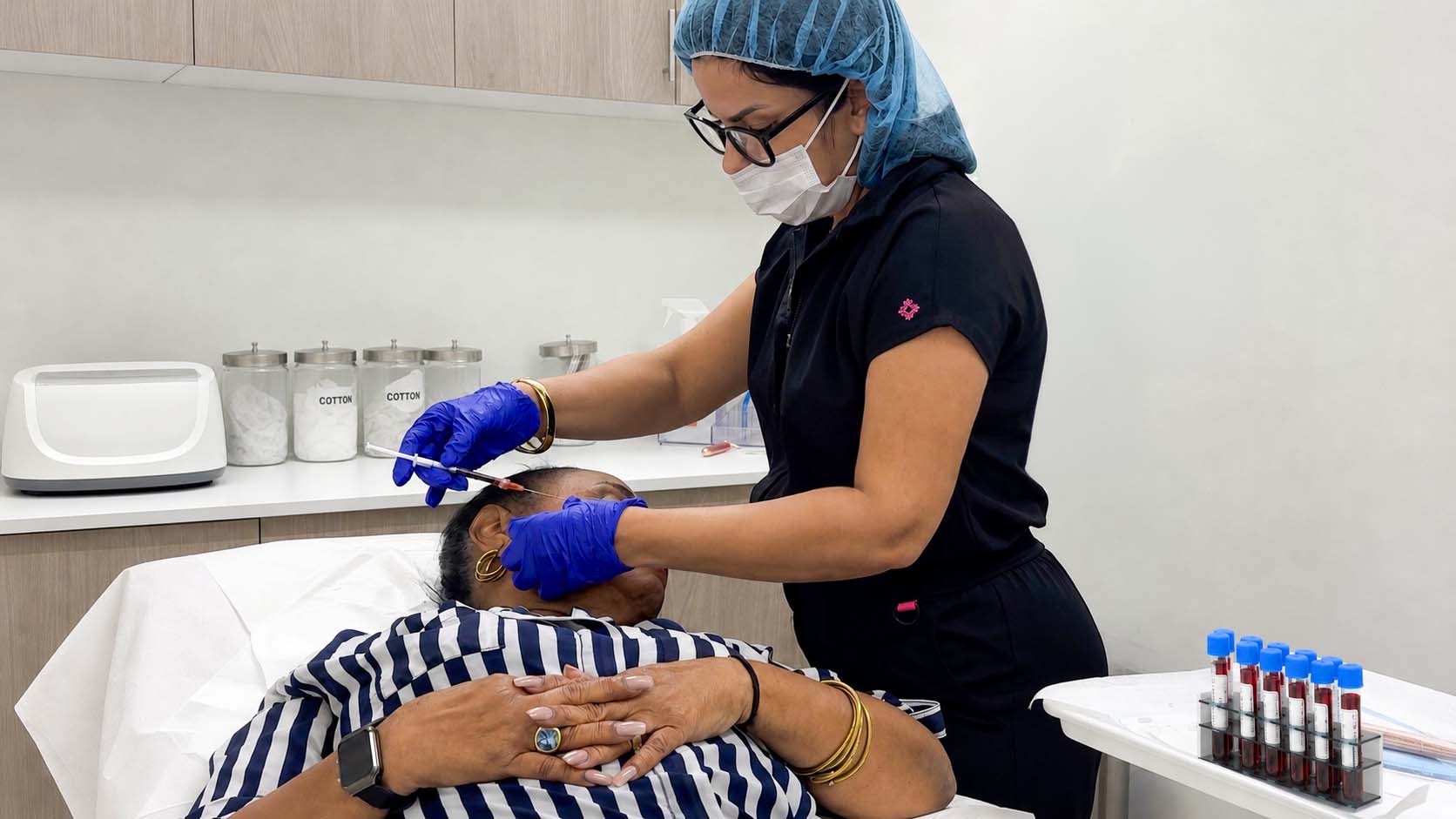
The procedure typically includes:
1. Blood Draw
A small sample of blood is collected.
2. PRF Preparation
The blood is processed using a centrifugation protocol to prepare Platelet-Rich Fibrin.
3. Scalp Preparation
The targeted scalp areas are cleansed and prepared.
4. PRF Application
The PRF is applied to selected areas of the scalp according to the personalized treatment plan.
Treatment time varies depending on the number of areas being treated.
How Many Sessions Are Usually Recommended?
There is no universal number of sessions for every patient.
A treatment series may be recommended depending on:
- Degree of thinning
- Duration of hair loss
- Hair loss pattern
- Scalp condition
- Age
- Individual response
- Treatment goals
Maintenance sessions may also be discussed depending on the patient’s progress and long-term plan.
When May Results Become Visible?
Hair growth is slow.
That means PRF should not be judged after only a few days or weeks.
Patients may begin noticing changes gradually over the following months.
Potential changes may include:
- Reduced shedding
- Improved hair quality
- Increased appearance of density
- Improved scalp condition
The timeline varies significantly by individual.
Hair follicles operate on biological growth cycles, so improvement develops progressively rather than instantly.
PRF for Men vs. Women
PRF may be considered for both men and women, but the causes of hair thinning can differ.
In Men
Common patterns include:
- Receding hairline
- Thinning crown
- Male pattern hair loss
In Women
Hair loss may appear as:
- Diffuse thinning
- Widening part
- Reduced density
- Hormonal-related changes
- Postpartum shedding
- Age-related thinning
Because female hair loss may have multiple contributing factors, a careful history and evaluation are particularly important.
PRF vs. Hair Transplant
PRF and hair transplantation are fundamentally different treatments.
PRF
- Non-surgical
- Uses the patient’s own blood-derived material
- Supports existing follicles
- Gradual
- No follicle transfer
Hair Transplant
- Surgical procedure
- Moves follicles from donor areas
- Used when structural restoration is needed
- Appropriate for selected patients with more advanced hair loss
PRF may be useful for patients who still have responsive follicles.
A transplant may be more appropriate when follicle loss is more advanced.
PRF vs. Topical Hair Treatments
Topical treatments act through different mechanisms than PRF.
Depending on the product, topical approaches may aim to:
- Influence the hair growth cycle
- Support follicle activity
- Improve scalp conditions
PRF, by contrast, provides a localized regenerative treatment using the patient’s own blood-derived components.
These approaches may sometimes be used together depending on the patient’s needs.
The appropriate treatment plan should be based on the cause of hair loss, not on a one-size-fits-all protocol.
PRF and Scalp Health
Hair restoration is not only about the hair shaft.
The scalp environment also matters.
Inflammation, dryness, poor scalp condition, or other local factors may affect how healthy the scalp feels and appears.
PRF is intended to support tissue quality and regenerative processes within the treated area.
This makes scalp health an important part of the treatment strategy.
Recovery and Aftercare
PRF hair restoration generally involves limited downtime.
Temporary effects may include:
- Mild scalp tenderness
- Redness
- Swelling
- Bruising
- Sensitivity
Patients should follow the specific aftercare instructions provided by their treating professional.
General recommendations may include:
- Avoid aggressive scalp treatments immediately after treatment
- Avoid excessive heat for the recommended period
- Follow hair washing instructions
- Avoid scratching or rubbing treated areas
- Follow all provider recommendations
Why Early Evaluation Matters
Hair follicles may become progressively weaker over time.
Once a follicle is no longer active or present, regenerative treatments may have limited ability to help.
That is why patients often benefit from evaluation earlier in the thinning process.
A professional assessment can help determine:
- Whether follicles are still present
- Whether PRF is appropriate
- Whether another cause needs investigation
- Whether combination treatment may be more suitable
- Whether surgical restoration should be considered
At Nature MedSpa, Hair Restoration with PRF is performed under the clinical direction of Yunet Fuentes, MSN, FNP-BC, Board-Certified Family Nurse Practitioner and Clinical Director.
Frequently Asked Questions
What is PRF hair restoration?
PRF Hair Restoration uses Platelet-Rich Fibrin prepared from the patient’s own blood and applied to the scalp to support follicle vitality, tissue quality, and the natural hair growth cycle.
Does PRF regrow hair?
PRF may support existing follicles and hair density in selected patients, but it does not create new follicles and cannot guarantee regrowth.
Is PRF good for thinning hair?
It may be appropriate for selected patients with early or progressive thinning, especially when follicles are still present.
Does PRF work for bald areas?
PRF is less likely to help areas where follicles are no longer present. A professional evaluation is necessary to determine whether regenerative or surgical treatment may be more appropriate.
How many PRF sessions are needed for hair?
The number varies by patient. A series may be recommended depending on the degree of thinning and individual response.
When will I see results?
Hair changes develop gradually over several months because follicles operate on biological growth cycles.
Is PRF better than PRP for hair?
PRF and PRP are both platelet-based treatments derived from blood, but their preparation and composition differ. One is not automatically better for every patient.
Is PRF hair restoration painful?
Patients may feel brief discomfort during treatment. Comfort measures may be used when appropriate.
Is there downtime?
Downtime is generally limited, although temporary redness, tenderness, swelling, or bruising may occur.
Can PRF be combined with other hair treatments?
Yes, depending on the patient. PRF may be incorporated into a broader plan that includes medical, topical, regenerative, or surgical options when appropriate.
Conclusion
Hair Restoration with PRF offers a regenerative approach for patients who want to support thinning hair and scalp health using components derived from their own blood.
The treatment does not replace missing follicles or guarantee hair regrowth.
Instead, its role is to support the biological environment around existing follicles and encourage healthier scalp and hair function over time.
For the right patient, PRF may become part of a broader strategy focused on preserving existing hair, improving scalp quality, and supporting long-term hair health.
At Nature MedSpa, every PRF hair restoration plan begins with a professional evaluation to determine whether regenerative treatment is appropriate for the patient’s specific type of hair loss.
Concerned About Hair Thinning?
Schedule a personalized hair and scalp evaluation at Nature MedSpa.
We’ll assess your pattern of thinning, scalp condition, and treatment goals to determine whether Hair Restoration with PRF may be appropriate for you.
Nature MedSpa
📞 (305) 306-8626
💬 WhatsApp: (305) 482-3823