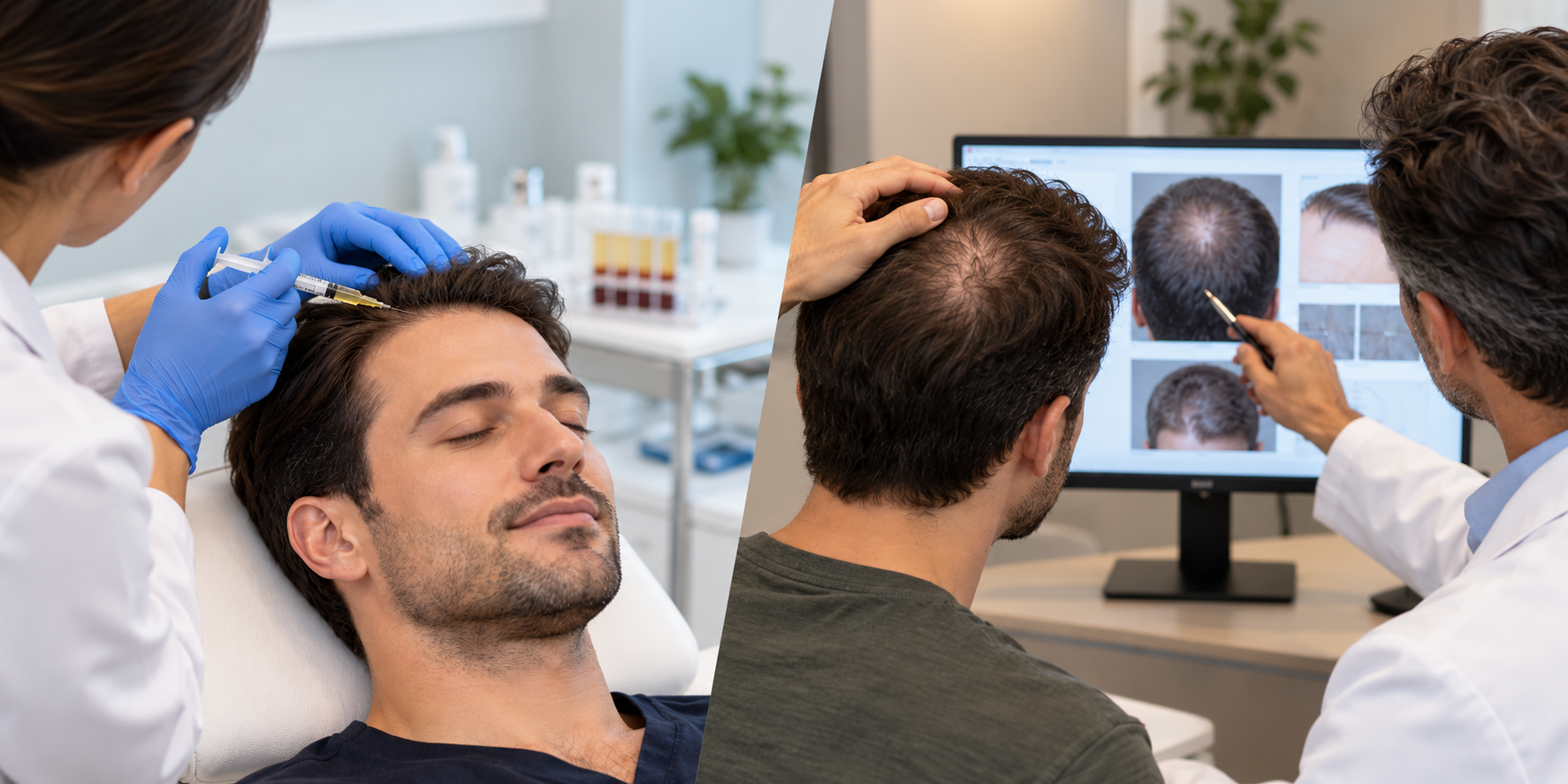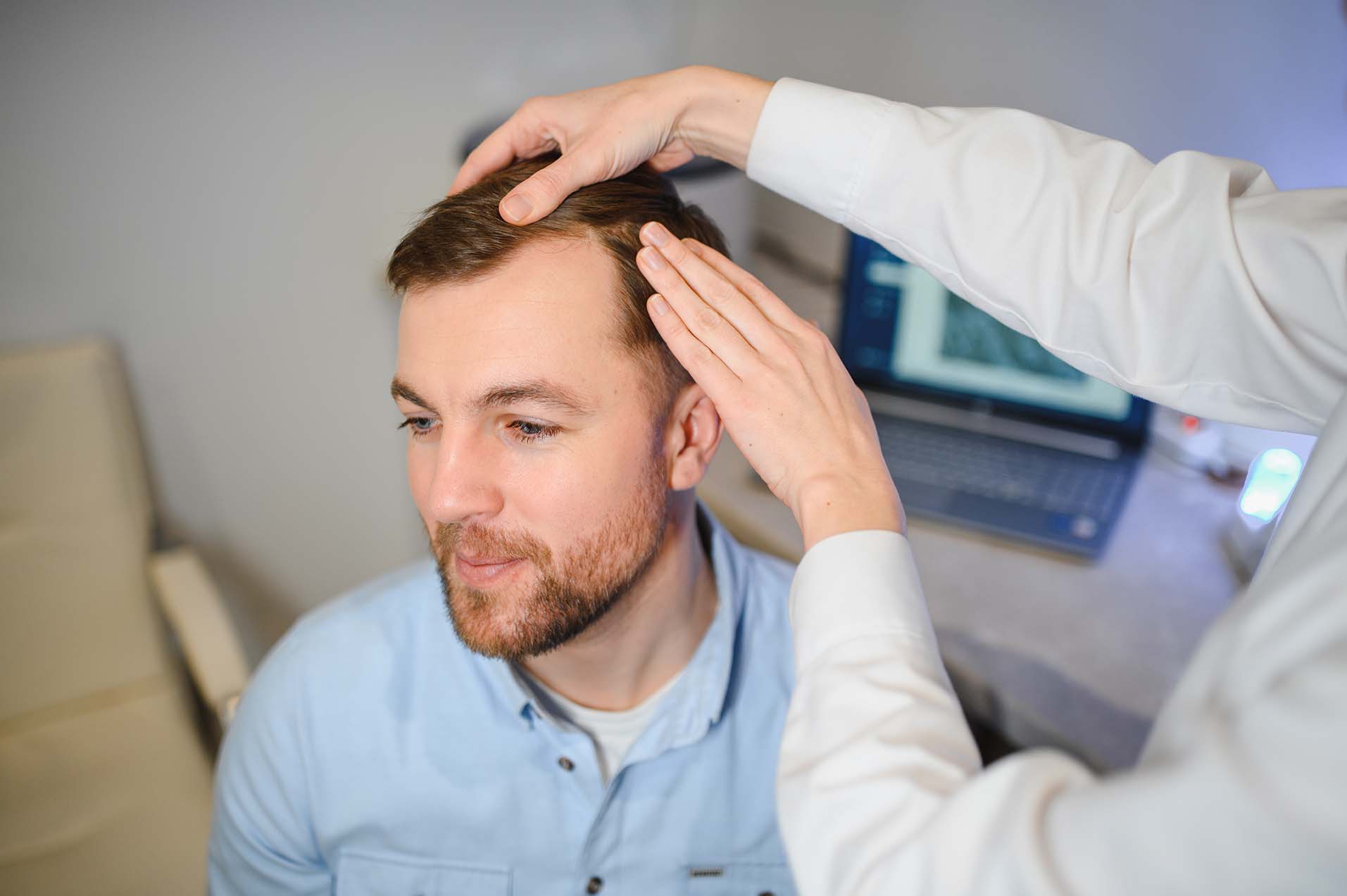


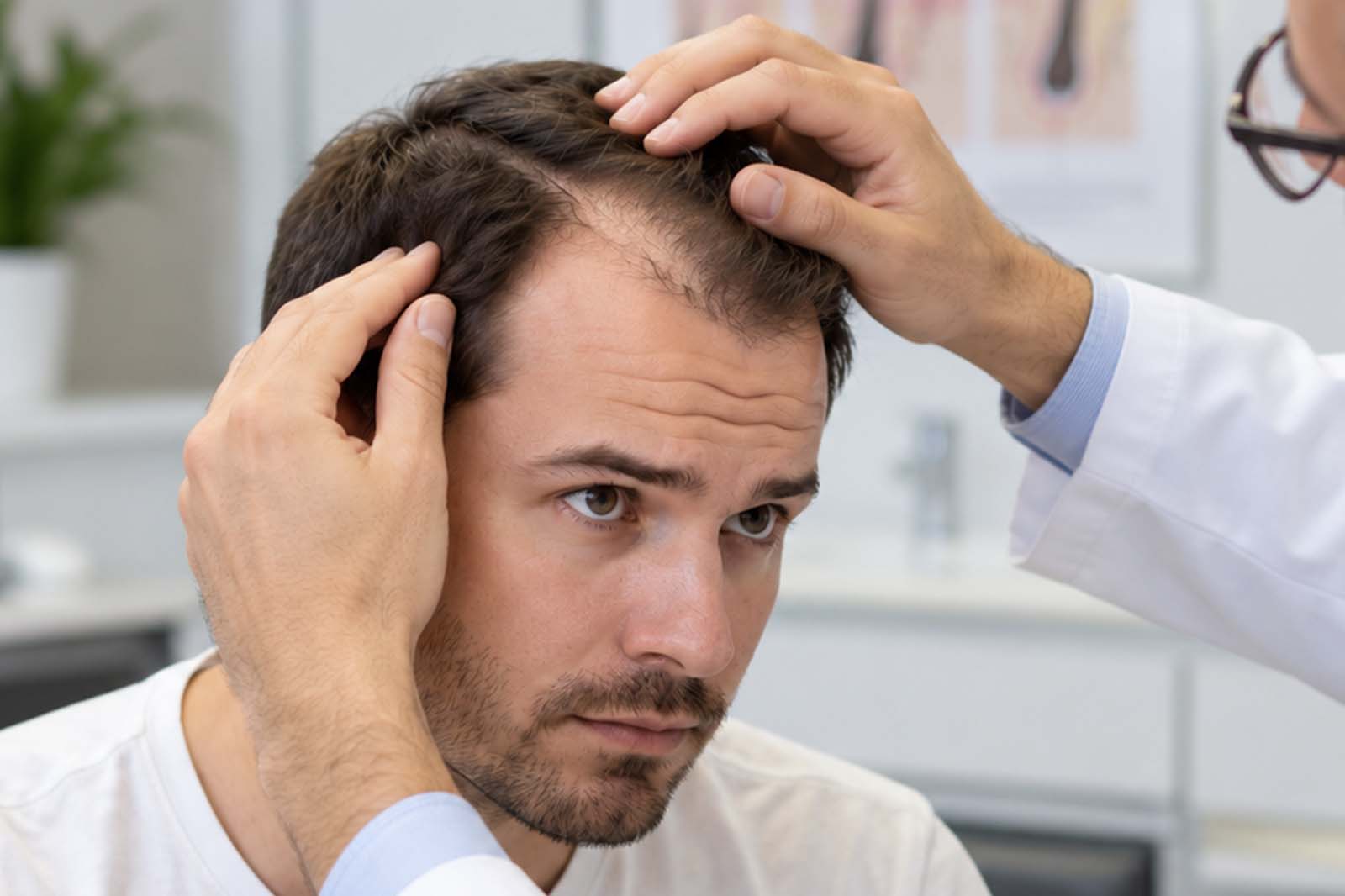
For many men, hair loss begins gradually.
- The corners of the hairline may move backward.
- The crown may look thinner under bright light.
- Hair at the front of the scalp may become finer.
- Or photographs from several years apart may reveal a change that was difficult to notice day by day.
Male pattern hair loss is extremely common, but it is not the only reason a man may experience thinning or shedding.
Hair changes can also occur because of illness, major stress, medications, nutritional factors, scalp conditions, autoimmune disease, traction, or other medical causes.
That is why recognizing hair loss is only the beginning.
The first question should not be “What treatment should I use?” It should be “Why is my hair changing?”
Understanding the cause, pattern, progression, and condition of existing follicles helps determine which treatment options may actually make sense.
Written & Medically Reviewed by Yunet Fuentes, MSN, FNP-BC
Board-Certified Family Nurse Practitioner
Clinical Director, Nature MedSpa
Table of Contents
- How Common Is Hair Loss in Men?
- What Does Male Pattern Hair Loss Look Like?
- What Causes Male Pattern Hair Loss?
- What Is DHT and How Does It Affect Hair?
- What Is Hair Follicle Miniaturization?
- Early Signs of Hair Loss in Men
- Receding Hairline vs. Mature Hairline
- Crown Thinning
- Hair Shedding vs. Progressive Hair Loss
- Can Stress Cause Hair Loss in Men?
- Other Causes of Hair Loss in Men
- When Should Hair Loss Be Evaluated?
- How Male Hair Loss Is Evaluated
- Treatment Options for Male Pattern Hair Loss
- Where PRF Hair Restoration May Fit
- PRF vs. Hair Transplant
- Can Hair Loss in Men Be Prevented?
- Frequently Asked Questions
How Common Is Hair Loss in Men?
Male pattern hair loss—medically known as androgenetic alopecia—is the most common cause of hair loss in men.
It can begin surprisingly early.
The American Academy of Dermatology notes that some men begin developing male pattern hair loss during their late teens or early twenties, although visible thinning becomes more common with increasing age.
A 2025 review in Nature Reviews Disease Primers describes androgenetic alopecia as a disorder characterized by progressive miniaturization of scalp hair follicles and a reduction in active follicles.
The severity and age of onset vary considerably.
Some men experience modest recession that progresses slowly over decades.
Others begin developing significant frontal or crown thinning at a much younger age.
What Does Male Pattern Hair Loss Look Like?
Male pattern hair loss usually develops in a recognizable distribution.
Common areas include:
- frontal hairline
- temples
- mid-scalp
- crown or vertex
The AAD describes male pattern hair loss as often beginning with a receding hairline or a thinning/bald area on the top of the scalp and progressing gradually over years.
A typical pattern may progress like this:
Temple recession → frontal thinning → crown thinning → increasing involvement of the mid-scalp
But not every man follows exactly the same sequence.
One person may notice the temples first.
Another may maintain the frontal hairline but develop a thin area at the crown.
Another may experience changes in both areas simultaneously.
What Causes Male Pattern Hair Loss?
Male pattern hair loss is not caused by one simple factor.
It involves a combination of:
Genetic susceptibility + androgen signaling + follicular biology + time
A 2024 review of the genetics of male androgenetic alopecia emphasizes that the condition has a substantial genetic component rather than being controlled by a single inherited gene.
More recent research has identified hundreds of genomic regions associated with androgenetic alopecia, highlighting just how biologically complex the condition is.
This is important because male pattern hair loss is sometimes oversimplified as:
“Too much testosterone.”
That is not an accurate way to describe it.
The sensitivity of susceptible follicles to androgen signaling is more important than simply having a high testosterone level.
What Is DHT and How Does It Affect Hair?
Dihydrotestosterone, or DHT, is an androgen formed from testosterone through the enzyme 5-alpha reductase.
In genetically susceptible hair follicles, androgen signaling—including DHT activity—can alter the normal growth cycle and contribute to progressive follicular miniaturization.
Current reviews describe androgen signaling as a central mechanism in male androgenetic alopecia.
But this does not mean that men with male pattern hair loss necessarily have abnormally high levels of testosterone or DHT throughout their body.
The issue involves the biological response of susceptible follicles.
That is why two men with similar hormone levels can have very different patterns of hair loss.
What Is Hair Follicle Miniaturization?
Miniaturization is one of the key biological processes behind male pattern hair loss.
A healthy terminal hair follicle normally produces a relatively thick, pigmented hair shaft.
In androgenetic alopecia, susceptible follicles gradually become smaller.
Over repeated hair-growth cycles, they may produce:
Thick hair → thinner hair → shorter finer hair → increasingly miniaturized hair
As more follicles undergo this process, scalp coverage decreases.
The 2025 Nature Reviews Disease Primers review identifies progressive follicular miniaturization and reduced numbers of active follicles as defining features of androgenetic alopecia.
This explains why early male pattern hair loss does not always look like dramatic shedding.
Sometimes the hair is still present—it is simply becoming progressively finer.
Early Signs of Hair Loss in Men
Possible early changes include:
- receding temples
- changes in the frontal hairline
- thinning around the crown
- greater scalp visibility
- reduced density at the front of the scalp
- progressively finer hair in affected areas
- a change in how the hair styles or holds volume
- increasing contrast between thicker hair on the sides and thinner hair on top
One photograph does not diagnose male pattern hair loss.
Progression over time is more meaningful.
Comparing photographs taken under similar:
- lighting
- hairstyle
- angle
- hair length
- wet/dry conditions
can sometimes make gradual changes easier to recognize.
For a broader explanation of these clues, see:
Receding Hairline vs. Mature Hairline
Men commonly search online for:
“Is my hairline receding or just maturing?”
There is no single photograph or measurement that can answer that question for everyone.
Some men experience relatively minor changes in the frontal hairline after adolescence without rapidly progressing hair loss.
Progressive male pattern hair loss, however, may involve continuing recession around the temples or frontal scalp combined with:
- decreased density
- finer hairs
- changes over time
- crown involvement
- family history
The important word is:
Progressive.
A hairline that continues to move backward or becomes accompanied by obvious miniaturization deserves closer evaluation.
Crown Thinning in Men
Some men do not notice frontal recession first.
Their earliest visible change occurs at the crown, also called the vertex.
Crown thinning may initially become obvious in:
- photographs from above
- elevators with overhead cameras
- bright bathroom lighting
- sunlight
- mirrors positioned behind the head
Because men rarely see this area directly, crown thinning can progress unnoticed.
The crown is one of the characteristic regions susceptible to male androgenetic alopecia.
Is a Bald Spot on the Crown Always Male Pattern Hair Loss?
No.
Pattern androgentic alopecia is common, but a bald or thinning area should not automatically be diagnosed based only on location.
Different conditions can produce focal or diffuse hair loss.
For example:
- alopecia areata
- inflammatory scalp disorders
- scarring alopecia
- infection
- traction or mechanical injury
may produce different types of hair loss.
Sudden, sharply defined, symptomatic, inflamed, painful, or unusual areas deserve professional evaluation.
Hair Shedding vs. Progressive Hair Loss
Men frequently interpret all hair found in the shower as evidence of male pattern baldness.
That is not necessarily the case.
The AAD notes that shedding approximately 50 to 100 hairs per day is normal.
When substantially more hair enters the resting/shedding phase, the process may represent telogen effluvium.
Potential triggers include:
- significant illness
- high fever
- surgery
- major weight loss
- substantial emotional or physiological stress
- certain medication changes
Excessive shedding may become noticeable several months after the triggering event.
Male Pattern Hair Loss vs. Telogen Effluvium
These conditions behave differently.
Male Pattern Hair Loss
Typically:
Gradual + patterned + progressive + follicular miniaturization
Telogen Effluvium
Typically:
Increased shedding + more diffuse + often associated with a trigger
However, the two processes can sometimes occur together.
For example, a man with early androgenetic alopecia can develop temporary telogen effluvium following a major illness.
The temporary shedding can then make previously subtle pattern hair loss much more noticeable.
Can Stress Cause Hair Loss in Men?
Yes, significant physiological or psychological stress can contribute to excessive shedding in some people.
But:
Stress should not become the automatic explanation for every case of hair loss.
If thinning continues progressively around the temples, frontal scalp, or crown, another process such as androgenetic alopecia may also be occurring.
Persistent hair loss deserves evaluation rather than indefinitely attributing it to stress.
Other Causes of Hair Loss in Men
Although androgenetic alopecia is extremely common, men can experience many other forms of hair loss.
Alopecia Areata
Alopecia areata is an autoimmune condition that can produce clearly defined patches of hair loss.
It may affect the scalp, beard, eyebrows, or other areas.
Its treatment is very different from the treatment of male pattern hair loss.
Scalp Conditions
Inflammatory, infectious, or scarring conditions can interfere with normal follicular function.
Hair loss associated with:
- redness
- scaling
- pustules
- pain
- burning
- significant itching
- scar-like scalp changes
should not simply be assumed to be genetic baldness.
Medication-Related Hair Loss
Certain medications can contribute to shedding or hair changes.
If a medication is suspected, it should not be discontinued without discussing the concern with the prescribing healthcare professional.
Nutritional and Medical Factors
Nutritional deficiencies or systemic medical conditions can contribute to hair changes in selected patients.
This does not mean that every man with hair loss should immediately begin taking multiple supplements.
Testing and supplementation should be based on the individual’s clinical history and findings.
Traction or Repeated Hair Trauma
Repeated tension can affect follicles.
While traction alopecia is often discussed in women, men can also develop traction-related hair loss depending on hairstyles and grooming practices.
Does Hair Loss Only Come From Your Mother’s Side?
No.
This is one of the most persistent hair-loss myths.
Male pattern hair loss has a strong genetic component, but inheritance is polygenic.
Genes associated with androgenetic alopecia can come through multiple parts of the family rather than exclusively through the maternal grandfather.
A 2024 genetics review discusses the complex hereditary architecture of male androgenetic alopecia, while larger genomic research has identified hundreds of associated loci.
So:
Mother’s side matters—but it is not the whole genetic story.
When Should Men Seek a Hair-Loss Evaluation?
Consider evaluation if you notice:
- progressive temple recession
- continuing frontal hairline changes
- crown thinning
- increasing scalp visibility
- persistent shedding
- clearly finer hairs in affected regions
- sudden patches
- rapid hair loss
- scalp pain or inflammation
- eyebrow or beard hair loss
- unexplained medical symptoms occurring with hair changes
Early recognition can be especially useful when follicles are beginning to miniaturize but remain active.
The AAD notes that men who start treatment relatively soon after noticing male pattern hair loss tend to have better opportunities for improvement than those who wait until loss becomes much more advanced.
How Is Hair Loss in Men Evaluated?
A proper evaluation involves more than looking at the hairline.
Relevant information may include:
Pattern
Is the change affecting:
- temples?
- frontal scalp?
- crown?
- entire scalp?
- localized patches?
Timeline
Has the change developed over:
- weeks?
- months?
- years?
Progression
Is the area stable or continuing to change?
Shedding
Has there been a recent increase?
Hair Caliber
Are hairs becoming progressively finer?
Family History
Is pattern hair loss present among relatives?
Medical History
Have there been:
- recent illnesses?
- surgery?
- major stress?
- medication changes?
- substantial weight changes?
Scalp Examination
Are there signs of:
- inflammation?
- scaling?
- scarring?
- infection?
Depending on the presentation, additional evaluation, laboratory testing, trichoscopy, or dermatologic referral may be appropriate.
The purpose is to establish:
What type of hair loss is actually occurring?
Treatment Options for Male Pattern Hair Loss
There is no single treatment appropriate for every man.
For confirmed male androgenetic alopecia, treatment strategies may focus on:
slowing progression + preserving existing follicles + improving density where possible
Treatment selection depends on:
- age
- stage of hair loss
- medical history
- progression
- expectations
- tolerance for medication or procedures
- long-term goals
Minoxidil
Topical minoxidil is FDA-approved for male pattern hair loss.
According to the American Academy of Dermatology, minoxidil can help some men:
- reduce further loss
- stimulate some hair growth
- strengthen existing hairs
Response varies considerably, and full restoration should not be expected.
Results also require continued use to maintain the medication’s benefit.
Finasteride
Oral finasteride is another FDA-approved treatment for male pattern hair loss.
It acts on the conversion of testosterone to DHT by inhibiting 5-alpha reductase.
The AAD reports that finasteride can slow further hair loss in many men and that some patients experience regrowth, particularly when treatment begins earlier in the hair-loss process.
However, finasteride is a prescription medication and can cause adverse effects.
Potential risks, medical history, expectations, and appropriateness should be discussed with a qualified prescribing professional before treatment.
Stopping treatment generally means losing the ongoing benefit over time.
Does Treatment Restore All Lost Hair?
Usually not.
This is one of the most important expectations to establish.
Hair-loss treatment is often more effective at:
preserving + supporting + improving
than completely rebuilding an advanced bald area.
The AAD similarly notes that minoxidil cannot restore an entire head of lost hair and that treatment tends to work better when started earlier.
This relates directly to follicular miniaturization.
As follicles become progressively smaller and less active, meaningful restoration becomes increasingly difficult.
Where PRF Hair Restoration May Fit
For selected patients, Platelet-Rich Fibrin (PRF) may be considered as part of a regenerative hair-restoration strategy.
PRF is derived from the patient’s own blood and contains platelets and other biological components within a fibrin-based matrix.
Its proposed role is to support the biological environment surrounding existing hair follicles.
The critical distinction is:
PRF does not create new follicles.
A 2024 review specifically examining PRF for androgenetic alopecia identified encouraging results in the limited clinical studies available but emphasized that preparation protocols remain inconsistent and that larger, well-designed studies are still needed.
A systematic review of injectable PRF reached a similar conclusion: early alopecia studies suggest potential improvements in hair growth and density, but stronger studies with standardized protocols and longer follow-up are necessary.
What About Newer PRF Research?
Research is continuing.
A 2025 prospective single-center study evaluated injectable PRF in 30 patients with androgenetic alopecia who had responded inadequately to conventional treatment.
After six monthly treatments, investigators reported improvements in several measured hair and scalp outcomes.
However, this was a relatively small, single-center study rather than a large randomized trial.
The appropriate interpretation is therefore:
Promising evidence — not guaranteed results.
PRF should be positioned as a potential option for selected patients, not as a replacement for appropriate diagnosis or established medical therapy.
For a detailed explanation, read:
Does PRF Block DHT?
PRF should not be presented as a DHT-blocking treatment.
This distinction matters.
Finasteride directly targets the androgen pathway by inhibiting conversion of testosterone to DHT.
PRF is a blood-derived regenerative treatment with a different proposed mechanism.
Therefore, statements such as:
“PRF blocks the hormone that causes baldness”
would be inaccurate.
Different approaches may address different aspects of hair restoration.
Can PRF Replace Hair-Loss Medication?
Not universally.
PRF and established medical treatments work through different mechanisms.
For men with androgenetic alopecia, medical therapy may be considered to address progression of the underlying condition.
PRF may potentially be incorporated into an individualized strategy for selected patients.
The decision should depend on:
Diagnosis + stage + existing follicles + medical history + preferences + realistic expectations
rather than assuming every procedure replaces medication.
PRF vs. Hair Transplant for Men
PRF and hair transplantation solve fundamentally different problems.
PRF
Works with existing follicles.
It does not move follicles from one part of the scalp to another.
Hair Transplant
Moves healthy follicular units from a donor area into areas where additional coverage is desired.
The AAD notes that transplant candidates require both adequate healthy donor hair and the ability to grow hair in the recipient area.
Therefore:
PRF supports follicles that are already present. A transplant redistributes follicles.
Neither treatment creates an unlimited supply of new hair follicles.
For a complete comparison, see:
PRF vs. Hair Transplant: What’s the Difference and Which May Be Right for You?
When Might a Hair Transplant Be Considered?
Hair transplantation may become part of the discussion when a patient has areas where greater follicular coverage is desired and sufficient donor hair is available.
Candidate selection requires consideration of:
- donor density
- age
- current hair-loss pattern
- expected future progression
- recipient area
- desired density
- medical suitability
- realistic expectations
Young men with actively progressing hair loss require especially thoughtful planning.
The AAD notes that some men in their twenties may be advised to delay transplantation and manage the underlying hair-loss process first.
Why?
Because a hairline designed today needs to continue looking appropriate if native hair continues thinning over the following decades.
Does a Hair Transplant Stop Male Pattern Hair Loss?
No.
A transplant relocates selected follicles.
It does not stop the underlying androgenetic process affecting susceptible native hairs.
The AAD specifically notes that thinning can continue after transplantation and that medical treatment may sometimes be recommended to reduce additional loss.
This distinction is extremely important.
A patient may have successful transplanted follicles at the hairline while continuing to lose native hair behind them.
That is why long-term planning matters.
What If Hair Loss Is Already Advanced?
Advanced hair loss changes what can realistically be achieved.
If follicles are still present but miniaturizing, treatment may focus on preserving or supporting them.
If substantial follicular loss has already occurred, treatments that depend on existing follicles may have more limited potential in that area.
Hair transplantation may provide another option if donor supply is adequate.
But donor follicles are finite.
Even hair transplantation cannot guarantee full original density in every patient.
The treatment objective must match the biological situation.
Can Hair Loss in Men Be Prevented?
Genetic male pattern hair loss cannot simply be prevented through:
- special shampoo
- frequent haircuts
- scalp massage
- vitamins
- avoiding hats
However, progression may sometimes be managed with appropriate evidence-based treatment.
Other preventable contributors—such as chronic traction, aggressive hair practices, or untreated scalp problems—may also be addressed when present.
The most useful strategy is often:
Recognize changes early → determine the cause → establish realistic goals → choose appropriate management
Common Myths About Male Hair Loss
“Wearing Hats Causes Baldness.”
Ordinary hat use is not recognized as a cause of male androgenetic alopecia.
“Hair Loss Means I Have Too Much Testosterone.”
Not necessarily.
Male pattern hair loss involves the response of genetically susceptible follicles to androgen signaling rather than simply an abnormally high blood testosterone level.
“It Only Comes From My Mother’s Side.”
False.
Male androgenetic alopecia has a complex polygenic inheritance pattern.
“Cutting My Hair Makes It Grow Back Thicker.”
Cutting the hair shaft does not change the biological behavior of the follicle beneath the skin.
“Once I Get a Hair Transplant, Hair Loss Is Over.”
False.
Native non-transplanted hair can continue thinning.
“PRF Creates New Follicles.”
No.
PRF should be described as supporting the environment of existing follicles, not generating entirely new ones.
Frequently Asked Questions
What is the most common cause of hair loss in men?
Male pattern hair loss, also called androgenetic alopecia, is the most common cause.
It typically develops gradually and affects areas such as the temples, frontal scalp, mid-scalp, and crown.
At what age does male pattern hair loss start?
It can begin during the late teens or early twenties in some men, although onset and progression vary considerably.
Visible signs become increasingly common with age.
What are the first signs of balding?
Possible early signs include:
- temple recession
- changing frontal hairline
- crown thinning
- increasing scalp visibility
- reduced density
- progressively finer hairs
Changes that continue over time are generally more meaningful than a single observation.
Does a receding hairline always mean I am going bald?
Not necessarily.
Some hairlines change after adolescence without immediately progressing to advanced hair loss.
Continued recession, miniaturization, crown thinning, or decreasing density may be more suggestive of progressive male pattern hair loss.
What causes male pattern baldness?
Male pattern hair loss develops through a complex interaction between genetics and androgen signaling in susceptible follicles.
DHT is an important part of that pathway, but the condition should not simply be described as having too much testosterone.
Does hair loss come from the mother’s side?
Not exclusively.
Genetic susceptibility to androgenetic alopecia is polygenic and can involve inherited variants from different parts of the family.
Can stress make men’s hair fall out?
Significant physiological or psychological stress can trigger excessive shedding in some people.
This can occur through telogen effluvium and may become noticeable months after the triggering event.
Is shedding hair the same as male pattern baldness?
No.
Excessive shedding and androgenetic alopecia are different processes, although they can sometimes occur simultaneously.
Does PRF work for male hair loss?
Early research suggests PRF may have potential as a regenerative treatment for selected patients with androgenetic alopecia.
However, current PRF evidence remains relatively limited, protocols are not fully standardized, and larger controlled studies are needed.
Does PRF block DHT?
PRF should not be described as a DHT blocker.
Its proposed regenerative mechanism differs from medications specifically targeting androgen pathways.
Does PRF grow new follicles?
No.
PRF does not create entirely new hair follicles.
Its potential role involves supporting the biological environment of existing follicles.
Is PRF better than a hair transplant?
They address different situations.
PRF works with follicles already present.
A hair transplant moves healthy follicles from a donor region into another area.
The appropriate approach depends on the stage and cause of hair loss, condition of existing follicles, donor availability, medical history, and goals.
When is it too late to treat male hair loss?
There is no universal cutoff.
However, treatments that depend on existing follicles generally have different potential when follicles are still active than when an area has experienced advanced follicular loss.
Professional evaluation can help establish what remains realistic.
Can a hair transplant permanently stop baldness?
A transplant can provide long-lasting transplanted hair, but it does not stop future loss of susceptible native hair.
Long-term hair-loss management may therefore remain important.
Conclusion
Hair loss in men is common, but understanding what is happening beneath the scalp is more important than simply noticing that the hairline has changed.
Male pattern hair loss involves the progressive miniaturization of genetically susceptible follicles.
For some men, it begins around the temples.
For others, the first noticeable change is crown thinning.
And for others, increased shedding may actually be related to a completely different process.
The most useful strategy is therefore:
Recognize the pattern
↓
Determine the cause
↓
Evaluate the existing follicles
↓
Understand progression
↓
Select an appropriate treatment strategy
Medical therapy, regenerative procedures such as PRF, hair transplantation, or other approaches may each have a role in selected patients.
But they are not interchangeable.
And no single treatment is appropriate for every form or stage of hair loss.
The earlier the cause and pattern are understood, the more informed the long-term hair-restoration plan can become.
Noticing Changes in Your Hairline or Crown?
A receding hairline, thinning crown, increased scalp visibility, or persistent shedding can have different causes.
At Nature MedSpa, hair-restoration planning begins with an individualized assessment of your:
hair-loss pattern + progression + scalp health + existing density + medical history + goals
When appropriate, PRF Hair Restoration may be discussed as part of a personalized regenerative approach.
- Explore PRF Hair Restoration
- Read: Early Signs of Hair Loss
- Read: Hair Restoration with PRF
- Read: PRF vs. Hair Transplant
- Meet Yunet Fuentes, MSN, FNP-BC
Medical References
- American Academy of Dermatology — What Is Male Pattern Hair Loss, and Can It Be Treated?
Clinical patient resource explaining male androgenetic alopecia, its common patterns, early treatment, FDA-approved medications, and procedural options. - Liu Y, et al. — Androgenetic Alopecia. Nature Reviews Disease Primers. 2025.
Comprehensive review describing androgenetic alopecia as a disorder involving progressive follicular miniaturization, altered androgen signaling in susceptible male follicles, genetic factors, and variation in onset and severity. - Sadasivam IP, et al. — Androgenetic Alopecia in Men: An Update on Genetics. 2024.
Review examining the complex genetic architecture involved in male androgenetic alopecia. - Chen S, et al. — Research Progress on the Pathogenesis of Androgenetic Alopecia. 2025.
Review discussing the biological mechanisms of androgenetic alopecia and progressive follicular miniaturization. - American Academy of Dermatology — Do You Have Hair Loss or Hair Shedding?
Clinical guidance explaining normal daily shedding, excessive shedding, telogen effluvium, and common physiological triggers. - American Academy of Dermatology — Hair Transplantation
Overview of transplant candidacy, donor requirements, recovery, expected timeline, and the potential for native hair loss to continue after surgery. - Shrestha S, et al. — Platelet-Rich Fibrin: A Review of Its Role as a New Treatment in Androgenetic Alopecia. 2024.
Review of published PRF protocols and clinical studies in androgenetic alopecia. The authors found encouraging preliminary results while emphasizing lack of protocol consensus and the need for larger, better-designed studies. - Mohale SA, et al. — Effectiveness of Injectable Platelet-Rich Fibrin Therapy in Alopecia and Facial Rejuvenation: A Systematic Review. 2024.
Systematic review reporting promising early findings for injectable PRF while emphasizing small sample sizes, limited controlled studies, and the need for standardized protocols and longer follow-up. - Injectable Platelet-Rich Fibrin in Androgenetic Alopecia. 2025.
Prospective single-center study of 30 patients reporting improvement in multiple hair and scalp measurements following six monthly i-PRF treatments. Results are promising but require confirmation through larger randomized studies.
Content Disclaimer
This article is intended for general educational purposes and does not constitute individualized medical advice. Hair loss in men may have multiple causes, including genetic, medical, inflammatory, nutritional, medication-related, autoimmune, or stress-related factors. Treatment suitability, risks, expected benefits, recovery, maintenance, and results vary by patient and should be discussed during an appropriate professional medical evaluation.